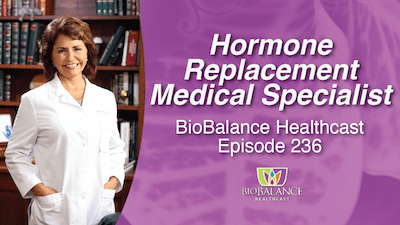
Dr. Kathy Maupin and Brett Newcomb discuss the current state of the medical field and the challenges that cutting-edge research on hormone replacement faces in an industry that’s slow to change.
One of the things that frustrates me the most about being a hormone replacement specialist is that it is not accepted as a medical specialty by the medical establishment. There are basically three or four approved or accepted specialists who are supposed to cover the things I do as a sex hormone replacement specialist. These variations of specialists remind me of the story of blind men trying to describe an elephant. They each could best describe what they encountered but none of them could “see” the elephant. These specialists are in the areas of Psychiatry, Obstetrics and Gynecology, Urology, Endocrinology, and research. Together they are the generally-accepted doctors who treat all the myriad of problems that could be helped or avoided by simply replacing sex hormones appropriately as they are naturally lost.
Part of my frustration comes from the fact that I am primarily a clinician who treats patients. I look at my patients as people with symptoms or illnesses that cause them distress and seek a way to alleviate these challenges. To accomplish this, I have done my own research across these speciality fields. I have read their individual journals, and have joined two international organizations of physicians who think and feel the way I do.
This new gathering of physicians who specialize in what we call “anti-aging medicine,” focuses on improving the quality and the longevity of the lives of their patients. We are not as concerned about how it has always been done and being right “on paper” as we are about making people stronger, healthier, and more symptom-free for as long as they live.
In the global sense, we are an orphan specialty. The pharmaceutical industry, the insurance industry, and the traditionalists among the medical industry have not yet recognized what we do and how we do it. They ignore or reject our research and our conclusions. To accept us and our works would mean that vested entities in the medical industries would be challenged to find new ways of working and generating revenue. They want the status quo to remain as it is. From this desire stems their resistance to the evidence we have accumulated and the work we have done.
I will continue to fight this inertia and try to educate my patients and my colleagues so that we are no longer an orphan or dismissed entity. Like Archimedes, if I can find a place to stand and a lever, I can move the world. Listen to my podcast and see how I am doing that.